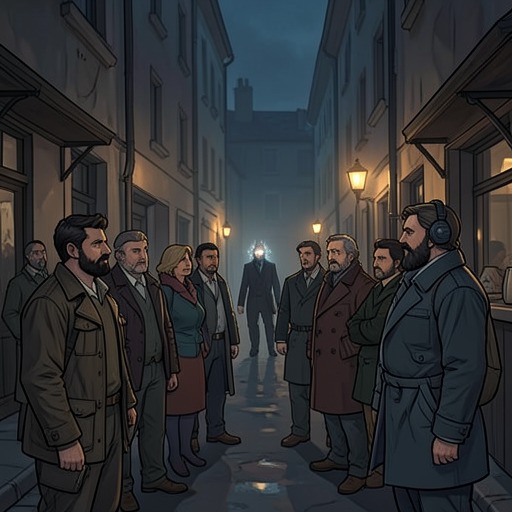
The Bloodline of the First Street Mansion
Blood CanticleThe revelation at the First Street House turns Mona’s unexplained survival into an explicit account of vampirism. Lestat tells Rowan and Michael that he transformed Mona because she was dying, describes the Blood and its consequences, and insists that the responsibility is his. The disclosure changes how both Mayfairs understand Mona: she is no longer dying, but she is also no longer human. For Michael, the truth makes it possible to receive and comfort her again without misunderstanding the nature of their bond.
Causes and Circumstances
Mona had been ill for years, and Lestat understood that her experience of life had narrowed to pain, treatment, exhaustion, and the hope of even a brief interval without suffering. When she reached for him and said she wanted the change, Quinn urged Lestat to save her. But Lestat’s later account does not present the decision as a straightforward, fully informed choice: he recognizes that a girl defined by pain and fear could not give meaningful consent. He accepts the decision as his own, rather than using Mona’s request to evade responsibility.
The disclosure takes place after Rowan has become physically agitated, with Michael trying to hold and calm her. Lestat separates Rowan from her husband and draws her attention to him. He explains that he acted because Mona was dying and tells Rowan to place the sin on him. The confrontation is therefore both an account of what happened to Mona and an attempt to contain the blame and fear surrounding it.
What Lestat Reveals
Lestat addresses both Rowan and Michael without speaking aloud, asking them to attend to his explanation. He identifies himself, Mona, and Quinn as vampires, and explains that the Blood has transformed Mona’s body. She is dead to human life, he says, but not merely an inert body: she has been filled with enlivening Blood and now thrives. She will live by feeding on human blood, while the night belongs to her and the sun cannot find her by day. The transformation is irreversible.
Lestat also frames vampirism as a condition of moral responsibility, not just a set of supernatural abilities. He describes the vampires as hunters who pass among human beings and says they hunt evil people; at the same time, he calls the Blood and its powers dark, and repeatedly accepts blame for what he has done. His confession does not erase the question of consent. Instead, he names the uncertainty directly: he did not consent to his own transformation, and Quinn had not said yes to his. The revelation exposes the gap between Lestat’s conviction that he saved Mona and the fact that he made an irreversible choice for her.
Rowan, Michael, and Mona
Rowan recognizes the truth as Lestat speaks. Her body goes rigid; after he falls silent, she closes her eyes and gasps, as though releasing a deep, unseen horror. She identifies Mona as a Blood Child and leans against Lestat. Her response marks the change from confrontation to comprehension, without suggesting that the revelation resolves every source of distress.
Michael initially looks down and withdraws into himself, weary and sad as the information settles in. Mona then goes to him and opens his arms. He receives her tenderly, kissing her cheek, mouth, and hair. His endearments recall the embrace he had given her shortly before, but understanding her nature alters the meaning of that closeness. He can comfort her freely as her father, rather than interpreting their attachment through a mistaken understanding of what she has become. The disclosure thus restores an intimate family bond even as it confirms Mona’s separation from human life.
Consequences and Significance
The event’s decisive consequence is a new shared understanding: Rowan and Michael now know that Mona’s survival came through Lestat’s intervention and that her life has irreversibly changed. Lestat’s repeated acceptance of blame makes the revelation a confession as well as an explanation. It places medical rescue, personal choice, and the limits of consent in tension: Mona wanted relief from suffering, but Lestat admits that her condition left her unable to consent fully to the choice he made.
The scene also refuses a simple opposition between salvation and damnation. Lestat sees that he has saved Mona from imminent death, yet he does not treat that outcome as proof that his action was morally innocent. Michael’s tenderness and Rowan’s recognition show that the family can respond to the truth with care, while Lestat’s self-accusation leaves the ethical cost of the transformation in view. The revelation does not undo the change; it makes its consequences intelligible to those closest to Mona.